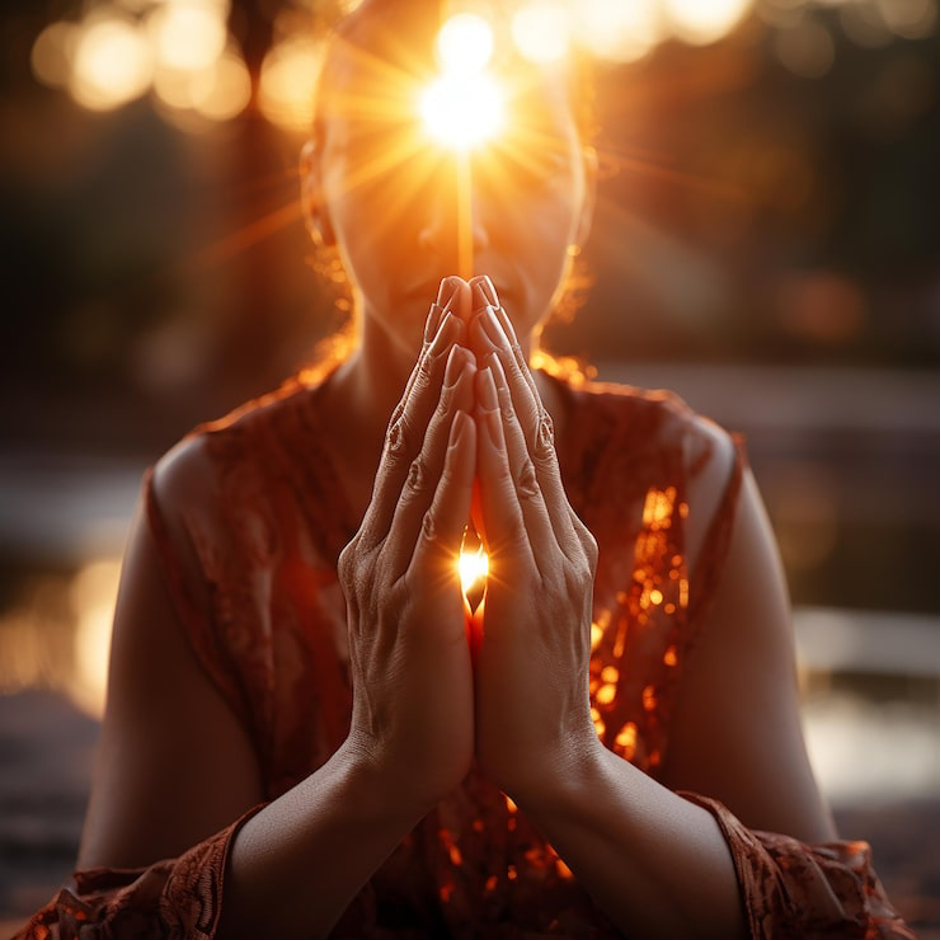
In this month of September, when we often have new intentions as we go back to school rythme, and with the days becoming shorter as autumn season unfolds, I wanted to talk to you about Sadhana. When we think about yoga, we often think about what happens on the mat: moving through postures, stretching, breathing and perhaps finishing with a peaceful Savasana. But yoga is so much more than that. One of the things I love about yoga is that, over time, it can become a way of life. It starts to influence how we breathe, how we react to situations, how we treat ourselves and others, and how we move through our everyday lives.
This is where the idea of Sadhana comes in.
Sadhana is a Sanskrit word meaning “a means of accomplishing something.”
In the yogic tradition, it refers to a regular spiritual or personal practice. But don't let the word “spiritual” put you off if that isn't really your thing! Sadhana can be very simple. It might be ten minutes of breathing in the morning, a short meditation, a few Sun Salutations, some journaling, sitting quietly with a cup of tea, or lighting a candle at the end of the day. The important thing isn't exactly what you do. It is the intention behind it and the fact that you keep coming back to yourself. Sadhana is about creating a little space in your day to pause, breathe and reconnect.
I think this is one of the most important things to understand about Sadhana. It isn't about having the perfect morning routine or practising yoga for an hour every single day. Some days you may have plenty of time and energy. Other days, you may be rushing around, feeling tired or simply not in the mood. That's life!
Your practice doesn't have to be perfect. It just has to be yours. The traditional teachings of yoga remind us that practice becomes stronger when we continue with dedication and consistency over time. That doesn't mean you can never miss a day. If you miss a day, you simply begin again. And beginning again is part of the practice too.
There is something very powerful about repetition. When we return to something regularly, we begin to build a relationship with it. We develop patience, discipline and awareness, and we start to notice changes within ourselves. Some days your practice might feel wonderful. Other days it might feel difficult, boring or like the last thing you want to do! But those difficult days can actually teach us a lot. When we practise even though we don't really feel like it, we begin to notice our habits and our resistance.
Maybe we tell ourselves: “I'm too tired” “I don't have enough time” “I'll do it tomorrow”
Sometimes simply noticing these thoughts is enough to learn something about ourselves. Sadhana isn't about forcing yourself or pushing through pain. It's about becoming more aware of your own patterns and gently creating new ones. Over time, this can help us develop a little more resilience and confidence – both on and off the mat.
There is no one “right” way to practise Sadhana. Yoga offers us many different tools, and you can choose what feels right for you.
Asana – yoga postures
A gentle morning flow, some Sun Salutations or a few restorative poses before bed.
Pranayama – conscious breathing
A few minutes of alternate-nostril breathing, another breathing technique, or simply slowing down and taking a few mindful breaths.
Meditation
Sitting quietly for five or ten minutes and observing your breath, repeating a mantra or simply noticing what is happening in your mind.
Mantra or chanting
Repeating a meaningful phrase, mantra or affirmation to help calm and focus the mind.
Gratitude and intention
Starting or ending your day by thinking about what you are grateful for or setting an intention for the day ahead.
Journaling
Writing down your thoughts, feelings, dreams or simply making a note of how your practice is going.
Svadhyaya – self-study
Reading a few pages of an inspiring or spiritual book, listening to a talk or taking some time to reflect on yourself.
Mindful activities
Going for a quiet walk, drinking your tea without looking at your phone, spending time in nature or doing something creative while being fully present.
Your Sadhana can be one of these things or a combination of several. And it can change. What you need today may not be what you need six months from now.
If you would like to introduce a little more regularity into your practice, my advice is simple: Start Small. You don't need to completely change your daily routine. Five or ten minutes is enough to begin.
Here are a few ideas:
I really like this idea. Your practice doesn't have to be “on” or “off”. Think of it more like a dial. Some days you might turn it up and enjoy a longer yoga practice, meditation or some journaling. Other days, you might turn it right down and simply take three conscious breaths. Both count. The important thing is to keep the connection alive.
Perhaps one of the most beautiful things about Sadhana is that it is something you do for yourself. We live in a world where so much of what we do is shared. We take photos, post things and show others what we are doing. But your Sadhana doesn't need an audience. It is the practice you return to when nobody else is watching. It is a quiet reminder of what matters to you and who you want to be. And the things we do repeatedly are the things that gradually shape our lives.
For me, this is really what Sadhana is about. Yoga isn't just the hour we spend on our mat. It is how we take that practice with us when we leave the studio.
It's the breath we take before reacting. It's choosing kindness when we could easily become frustrated. It's listening to our body. It's taking a moment to pause when life feels overwhelming. It's making time for ourselves, even when life is busy. Little by little, yoga moves from something we do to something we live. And you don't need to be flexible, experienced or able to do a handstand! You simply need to start where you are. Maybe today your Sadhana is a 10-minute yoga practice. Maybe it's five minutes of meditation. Maybe it's simply sitting quietly with a cup of tea and taking a few deep breaths.
Whatever you choose, make it yours.
Your practice doesn't have to be perfect. It just has to be yours. 🧘♀️✨
Namaste
Christel 🙏


 Français
  English (UK)