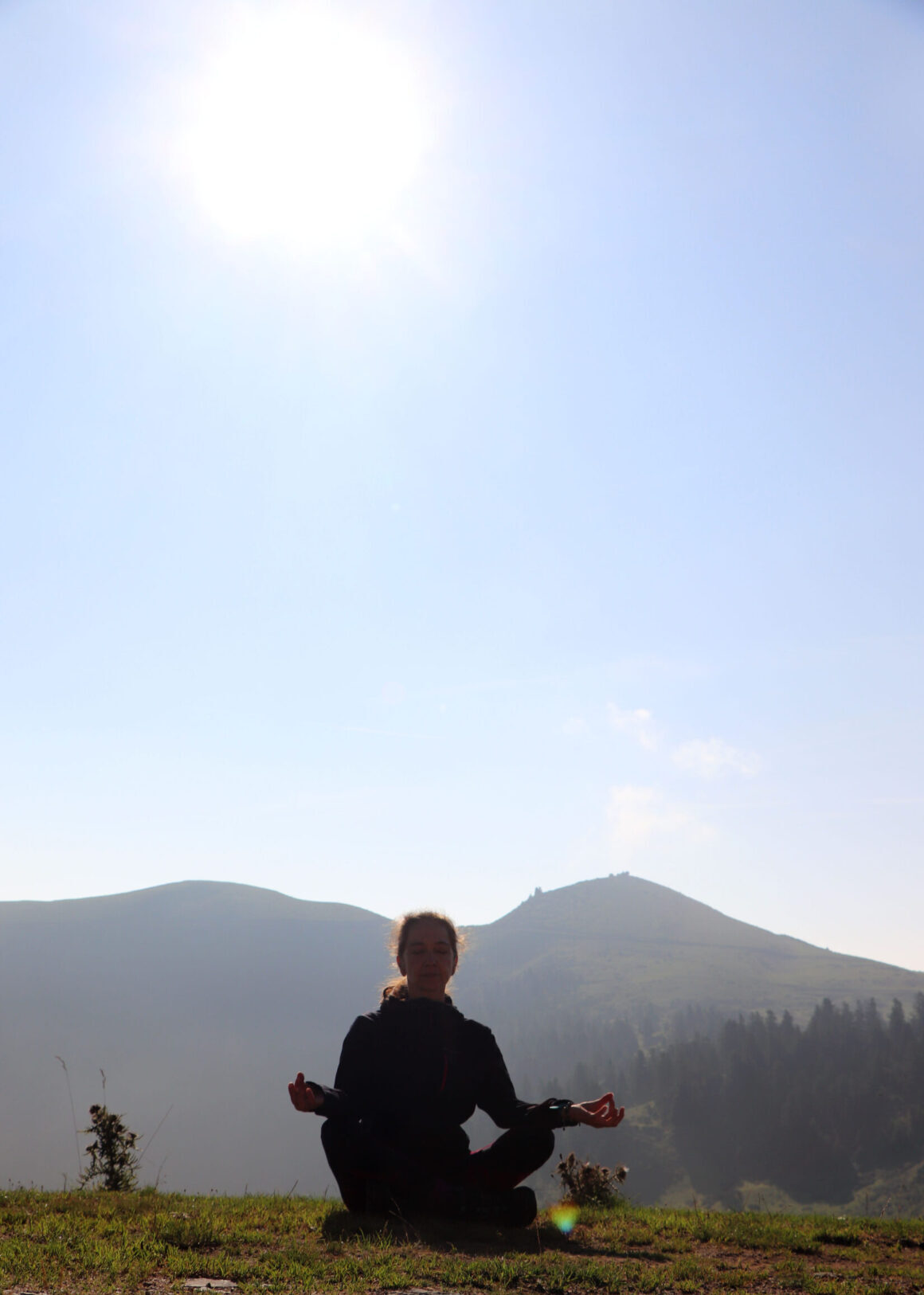
As we approach the end of summer and start getting back into our usual routines, many of us are thinking about returning to yoga classes, starting a new practice, or simply making a little more time for ourselves.
I thought this would be the perfect moment to explore the meaning of Ahimsa, especially as it is the name of the yoga studio where most of my classes take place in Estancarbon. But what exactly does Ahimsa mean, and what does it have to do with yoga?
When we think of yoga, we often think of the physical postures – the asanas – but yoga is so much more than what happens on the mat.
Le Yoga Sutras of Patanjali are one of the foundational texts of yoga philosophy. They describe what is known as the Eight Limbs of Yoga, with each limb offering guidance for our journey of yoga, both on and off the mat.
The first limb is made up of the Yamas. These can be understood as ethical principles or guidelines for how we relate to ourselves, to other people and to the world around us.
There are five Yamas:
And the first of these is Ahimsa.
The word Ahimsa is usually translated as non-violence or, perhaps more meaningfully, non-harming. Himsa means harm or violence, while the prefix a- means "not". But Ahimsa is about much more than simply not physically hurting another person.
It invites us to become aware of the ways in which we can cause harm – through our actions, our words, our thoughts and even the way we treat ourselves. It can mean choosing kindness over anger, compassion over judgement and understanding over criticism. It also encourages us to consider how our choices affect other living beings and the natural world.
Patanjali expresses the power of Ahimsa beautifully in Sutra 2.35:
“In the presence of one firmly established in non-violence, all hostilities cease.”
What a beautiful idea – that when we cultivate peace within ourselves, it can influence the people and environment around us. One of the best-known examples of Ahimsa in modern history is Mahatma Gandhi, who made non-violence one of the central principles of his life and work. But we don't need to change the world on a huge scale to practise Ahimsa. Sometimes it starts with something much simpler: the way we speak to ourselves.
Whether you're completely new to yoga or have been practising for years, it's very easy to become frustrated with our physical practice. Maybe our body isn't as flexible as we'd like. Maybe we can't hold a pose for as long as someone else. Perhaps we're comparing ourselves with the person on the mat next to us – or with the version of ourselves we were six months ago.
This is where Ahimsa can become a beautiful part of our practice. Non-harming means learning to listen to our bodies rather than fighting against them. Of course, yoga can challenge us. We can explore our edges, build strength and gradually develop greater flexibility. But there is a difference between challenging ourselves and pushing ourselves into pain. And really, who cares if you can put your leg behind your head or hold a handstand for five minutes?
Yoga isn't a competition. By respecting our boundaries and listening to what our body needs today, our practice becomes more sustainable – and we begin to learn something much more valuable: how to accept ourselves exactly as we are.
When we let go of the idea of what we should be able to do, and stop criticising our bodies for what they can't do, something changes. The body stops becoming an obstacle and starts becoming a pathway to greater awareness and freedom.
A question I often hear is:
“Do I have to become vegetarian or vegan because I'm practising yoga?”
It's an interesting question, particularly when we consider that Ahimsa encourages us to avoid causing harm to other living beings. For some people, this naturally leads towards vegetarianism or veganism. For others, changing their diet completely may not feel right or may not be practical. As with so many aspects of yoga, I believe there is room for awareness, balance and personal choice. Perhaps you could eat less meat. Try a few more vegetarian or vegan meals each week. Choose locally produced or organic food where possible. Support companies that care about the environment and their workers. Buy fair-trade products.
The important thing is to become more conscious of our choices and the impact they have – on our bodies, other living beings and the planet. There is no need for perfection. Small, mindful changes can make a difference.
If you're interested in this subject, you can also read my blog “What Do Yogis Eat?”, where I explore the idea of a yogic diet in more detail.
Perhaps one of the most challenging – and rewarding – ways to practise Ahimsa is through our thoughts. We can eat well, exercise, practise yoga and do all the things we believe are good for our health, but what happens inside our mind matters too.
How often do you catch yourself thinking:
I'm not good enough.
I'm too old for this.
My body doesn't look right.
I'll never be able to do that.
Why can't I be more like them?
We can be incredibly kind to other people while being surprisingly harsh towards ourselves. Ahimsa invites us to notice these thoughts without judging ourselves for having them. We can then begin to replace that inner criticism with something a little kinder. This doesn't mean pretending that everything is wonderful all the time or forcing ourselves to think positively.
It simply means asking:
“Would I speak to a friend the way I am speaking to myself?”
If the answer is no, perhaps it's time to practise a little more Ahimsa. The same applies to the thoughts we have about other people. Jealousy, anger, resentment and judgement can be exhausting emotions to carry. Even when they are directed towards someone else, they affect us. Cultivating compassion doesn't mean allowing people to treat us badly or ignoring difficult situations. It means choosing, where possible, not to add unnecessary hostility to an already difficult situation. And perhaps this is where the real beauty of Ahimsa lies.
Yoga doesn't ask us to be perfect. It simply invites us to become more aware.
We can practise Ahimsa when we listen to our body instead of forcing it.
We practise it when we choose nourishing food and become more conscious of where it comes from.
We practise it when we catch ourselves being self-critical and choose a kinder thought instead.
We practise it when we pause before reacting in anger.
We practise it when we choose compassion – for ourselves, for other people and for the world around us.
And just like the physical practice of yoga, Ahimsa is a practice.
Some days we'll get it right. Some days we won't. That's okay. The next time you step onto your yoga mat, perhaps take a moment before you begin and ask yourself: “How can I practise a little more Ahimsa today?”
You might be surprised by where the answer takes you.
If you'd like to explore yoga beyond the physical postures, I'd love to welcome you to one of my classes.
I teach regular Vinyasa and Yin Yoga classes at the Studio Ahimsa in Estancarbon, as well as classes in the beautiful little village of Soueich.
Whether you're completely new to yoga or returning to your practice after a break, you're very welcome.
Sometimes, the most important part of yoga is simply showing up – and being kind to yourself while you're there.
Namaste
Christel


 Français
  English (UK)