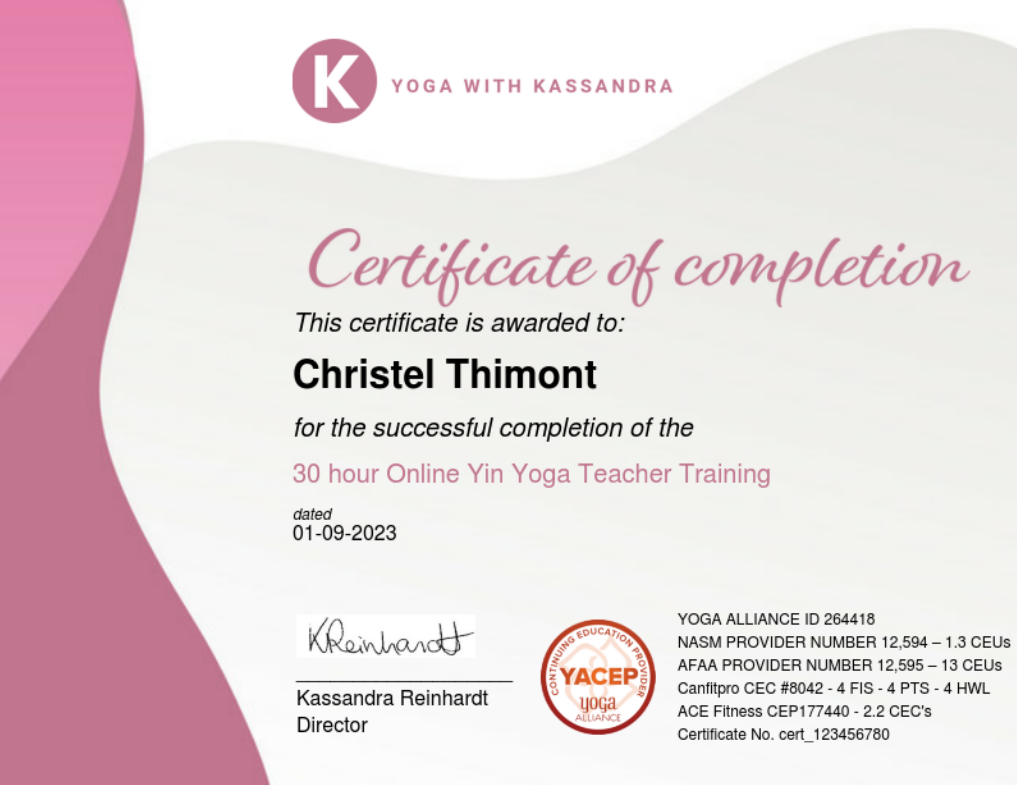
As announced on my social media accounts, I recently qualified as Yin yoga instructor following an online training with Kassandra Reinhardt.
Having been a long-term fan of Yin yoga, I really wanted to share this passion of mine with my students so they can also benefit from this practice that so few know about!
I can hear you already: Yin what?? Well let me explain...
Yin is a slow-paced style of Yoga, where postures are held for between three and five minutes. A modern interpretation of ancient Yoga practices, Yin was pioneered in 1980s California and typically features poses held for anywhere between three and twenty minutes each. The poses are held for a long period of time to target the connective tissues (such as the ligaments) rather than focusing on the muscles. As a result, the asanas are more passive holds, with little muscular engagement.
To help you sink into the poses, your body is supported with props to allow you to relax, breathe into the stretch and allow gravity to do most of the work. The aim is to bring mental, physical, and spiritual together as it stimulates our 'Nadis'. Similar to meridians in Chinese medicine, Nadis are considered to be pathways in the body that carry energy, water, air, blood and bodily fluids around. You might also hear them referred to as 'energy lines'.
Yin has something for everyone, but if you're hypermobile in certain areas of your body and already have plenty of space around your joints, Yin must be practised with caution. There is no need to go to your full range in order to experience the energetic benefits. Prop yourself with whatever you need to keep your body safe.
The benefits of Yin Yoga:
· Reduces stress and anxiety
· Helps to promote mindfulness
· Improves joint mobility
· Improves flexibility
· Elongates and stretches tight muscles
· Can promote feelings of deep calm
Yin is an incredible amalgamation of yoga postures and Chinese medical theory of energy channels (meridians). The benefits stem from the stimulation of certain energetic pathways that run through our bodies. Due to the intensity of our modern lives, we tend to disrupt the fluidity of our energy which, in Chinese medicine, is explained as "stagnant" energy or "depleted" energy.
It can manifest in many ways from insomnia, lethargy, exhaustion, racing thoughts, body pain and so on. When we rebalance our energy by targeting these channels, we start to bring much more equilibrium into our daily lives.
It’s also a surprisingly meditative practice that teaches you to overcome discomfort through breath and positive thinking, reducing stress and anxiety.
As well as the necessary breathwork that is involved in keeping intense postures for a considerable length of time, Yin greatly improves flexibility and joint mobility that will see you progress in all areas of your yoga practices.
This makes it hugely beneficial alongside cycling, running and other exercises that shorten the muscles.
Due to the pace, it teaches you a lot about the body; not just how small movements can change postures, but about how everything's put together.
How does Yin Yoga calm you down?
Famed for its ability to take us from reactive to relaxed, Yin is lauded for how calm it makes people feel afterwards. But what's actually happening in our bodies?
Yoga activates the parasympathetic nervous system (the "rest and digest" response to life) through breath work and postures like child’s pose and Savasana.
When you are stressed out, your body pumps out the hormone cortisol. This hormone is what helps you keep going in a crisis (it’s the key to the "fight or flight" response). Unfortunately, when it comes to stress levels, your body can’t distinguish between a lion giving chase and your boss sending a snarky email, which means many of us are flooded with cortisol on a daily basis. This leads to an overworked nervous system, fatigue and ill health.
Making time for Yin Yoga amongst our busy schedules can be the tonic we need to switch from stressed out to chilled out.
What parts of the body does Yin focus on?
Yin is mainly centred on the bottom half of the body, with variations of supine (flat on your back) and seated poses. As a fairly static style of yoga, it's intended to be practised alongside more dynamic practices such as Vinyasa, Ashtanga and Hatha.
Yin yoga is a still and meditative practice that moves us deeply into body and breath awareness. By bringing the physical body into specific poses, in stillness and for a prolonged time, we are able to create a significant autonomic shift not otherwise possible in our busy modern lives. We move out of that frustrating place of being both tired and wired, and start to enter the space of restoration and rejuvenation.
Is Yin Yoga the same as restorative yoga?
Not quite. Unlike restorative, it’s not focused on helping injured bodies back to health or restoring energy levels, but stretching into the fascia; the sheet of connective tissue below the skin that encases the muscles.
While both focus on relaxation and breathing, Yin can be uncomfortable — requiring exhaling into intense stretches (though it should never be painful; if that happens, you should pull back or come out of the posture immediately).
What are the origins of Yin Yoga?
While you can trace other schools back thousands of years, Yin started in 1980s California. Though the inventor is generally thought to be Paulie Zink, some say his style was more like Taoist yoga or even martial arts. Yin, as it is today, was in fact created by Paul Grilley.
Yin Yoga has its roots in China, unlike the more popular and active yoga disciplines, which originated in India. It was founded on the Taoist theory of yin and yang – opposite concepts that, together, represent balance. While Yin is slow, stable, passive and feminine, yang is hot, changing, active and masculine — like Vinyasa, Ashtanga and more dynamic styles.
The yin poses, therefore, are passive and performed while seated or in a reclining position. The poses are held with the muscles fully relaxed, allowing time and gravity to deepen the stretch and target the fascia. The time spent holding these asanas is similar to meditation.
In the body, the tendons, ligaments and fascia are yin, while the muscles and blood are yang; hence yin practices focus on stretching into the fascia.
Yin yoga poses tend to resemble poses used in other disciplines, but use different names. Despite the similarity of the poses, the yin versions are performed differently from their active, or yang, relatives. For example, the yin caterpillar pose resembles Paschimottanasana, or seated forward bend. In caterpillar, however, the spine rounds so that the head comes to the knees, whereas in Paschimottanasana, the spine remains straight and lengthens as the head reaches toward the feet.
If you practice only dynamic forms of exercise or yoga, you will gain muscle strength, but not necessarily a wider range of motion. To have a healthy range of motion around our joints, many of us need to also stretch the deep connective tissue and the joints. Yin is practiced cold with no warm up and with more of a focus on flexibility and lubrication. Suitable for almost all levels of students, Yin Yoga is a perfect complement to the dynamic and muscular (yang) styles of yoga.
While initially this style of yoga can seem quite boring, passive, or soft, yin practice can be quite challenging due to the long duration of the poses. We can remain in the postures anywhere from one to twenty minutes!
Both yin and yang styles should be practiced to invite balance into your yoga regime.
5 things to expect from a Yin Yoga class
The fascinating thing about a Yin class is that it is incredibly challenging!
1. You might feel a little uncomfortable
I believe it is one of the hardest physical yoga practices out there. Although you should never feel pain, it’s likely you will experience some discomfort as the poses are designed to target areas of tension and holding, so can feel super intense. It’s not about the strength of muscles, it’s about sitting with sensation and learning to let go. Surrender.
2. There are a few props involves
As well as fewer postures, it’s not a particularly flowy form of yoga as it requires getting yourself set up with a lot of props — including blocks, blankets and bolsters (which are like a long, tubular cushion).
3. The poses have different names
No Sun Salutations here; and there's also no Sanskrit. Remember, this type of yoga came from California. Instead, the postures are called by illustrative English names like Butterfly, Cat Tail and Dragon.
4. You won't get as warm so wear more layers
Typically, people wear more clothes than in faster classes – opting to layer long sleeve and short sleeve layers. This is due to the still nature of the practice, as staying in poses for extended periods of time will cause your body temperature to drop. Socks, long leggings and a jumper are advisable.
5. You won't want to schedule anything intense afterwards
One thing we have to let you know is that you may feel a little spacy post-practice. Sometimes dubbed 'Yin brain', you'll most likely be at peak relaxation, so try not to plan anything too strenuous post-practice.
Yin will leave you feeling totally zen – and as you get more accustomed to it, you’ll start to really feel the shift in your nervous system.
Like any type of yoga, the more you practice Yin yoga, the more you will reap the benefits and enjoy a more balanced and grounded life thus allowing you to enjoy true wellness and good health.
I hope you have learnt a bit through this blog. If you have any more queries about Yin Yoga, please do contact me directly. I will more than happy to share my knowledge of this amazing discipline with you.
Namaste
Christel 🙏


 English (UK)
  Français