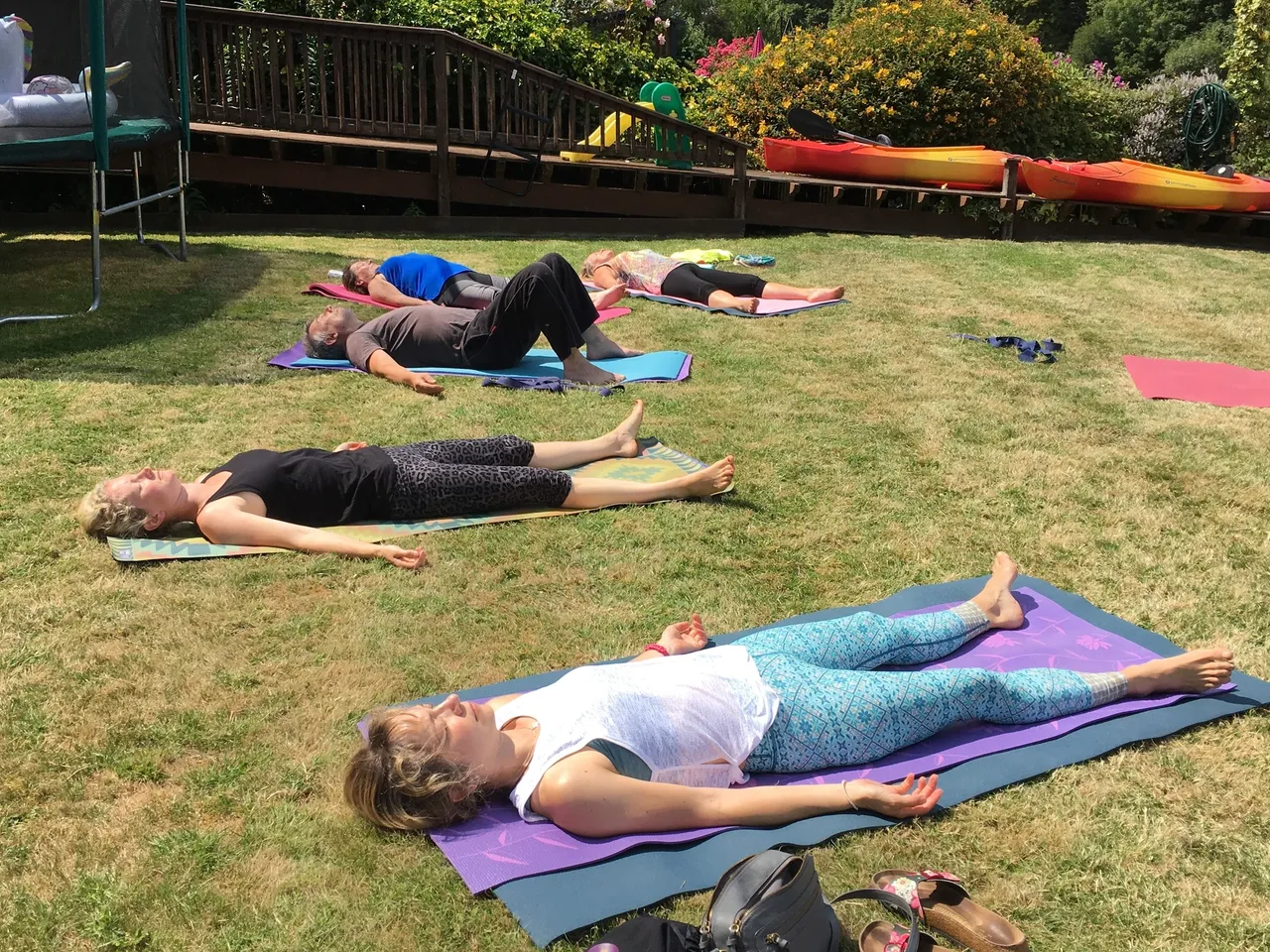
With Christmas just over, I imagine your stress levels being very high. Running around preparing for the big day with your family and friends can really takes its toll on your wellbeing. Hence I am writing today about what the most important asana of every practice: Savasana, the final relaxation.
Already in 1966, B.K.S. Iyengar wrote in Light on Yoga that “The stresses of modern civilization are a strain on the nerves for which śavāsana is the best antidote” (page 424), and those stresses have intensified for many of us, making savasana even more vital now.
“An entire class of savasana or restorative poses is often what the 21st-century citizen needs to counterbalance an urban life, but we 21st-century urbanites are often addicted instead to the heavy sensation of deep stretch, so we want a highly stimulative class,” says Tom Myers, author of Anatomy Trains.
Given our craving for intense stimulation, surrendering to savasana may not always be easy, but understanding the value of the pose may help to practice it more often.
THE BENEFITS
“The main benefit of savasana,” says Myers, “is an act of self-remembering, a chance for the nervous system to appreciate the changes wrought by the exercise, for proprioception, interoception, and the autonomic balance to restore itself.”
This self-remembering may be possible because of the profound relaxation savasana offers. According to Dr. McCall, a physician specializing in internal medicine and author of Yoga as Medicine: The Yogic Prescription for Health and Healing, who can be seen on the YouTube channel Ask the Yoga Doctor, “The relaxation in savasana is deeper than the relaxation of just lying down on a couch; this has been shown in scientific studies. You go more deeply into toning the parasympathetic nervous system, getting into that rest-and-digest mode, that restorative mode, in savasana.”
Savasana offers a chance to release any tightness your body is holding onto despite, or even because of, your yoga practice. Noah Mazé, co-founder of The Mazé Method, says “Savasana helps you release residual tension. This way you don’t carry all that tension into your next activities or train your body that it always has to be ready to go go go.” According to Mazé, “Even a short savasana can leave you feeling deeply rested and refreshed.”
Yogarupa Rod Stryker, who has studied with Tigunait, also sees savasana as benefiting the subtle body. “Resting in savasana at the end of class may be the single most important asana when it comes to the physical practice of yoga,” says Stryker. “Throughout a class, the physical postures help to unblock the flow of prana (life force). The result is that the organs, nervous system, and brain are all nourished. This has a profound impact on the mind. However, these benefits do not fully blossom unless you rest. Only then do these energies become fully balanced and absorbed.” In savasana, “The mind experiences itself becoming absorbed into something greater than itself—shifting from fragmentation to unification—imbuing it with an experience of its source.”
INCREASING EASE IN SAVASANA
If, after exploring savasana’s benefits, you would like to make the pose a priority but find relaxing into it a challenge, there are a few things that you can do to make savasana more inviting, and even more valuable.
1. Pronounce it correctly.
The relaxation savasana conjures may well begin with the sound of the word. Śava means ‘a corpse, dead body,’ i.e., a restful state. The seed sound “ś” of śava is the same as the initial sound of śānti (peace, rest, calmness of mind). ‘Shhh’ is the calming sound that helps a person relax, it is not the same as the ‘sss’ of a snake.
Experiment: Does softening the initial “s” set the stage for quiet, and make the pose even more inviting?
2. Do something active first.
Exertion before savasana pays off, we do know for sure that the relaxation will be deeper if first you’ve done something to, so to speak, burn off some of the steam.
If your mind is going a hundred miles an hour, you may not be able to relax at all in savasana, and sometimes a more exerting yoga practice can help you get to that place of relaxation.
Experiment: Would upping the intensity of practice before savasana help you to be still?
3. Use props.
If you are restless in savasana, one radically simple reason could be that you are not perfectly comfortable lying flat on your back.
If you ever feel tension in your lower back in savasana, try putting a bolster behind your knees, as that can often help promote relaxation in the pelvis and lower back. Additionally, placing a folded blanket behind the head can feel more comfortable, especially if the floor is quite firm, and promote a calming effect on the nervous system.
Experiment: Would placing a bolster under your knees, a blanket under your head, or an eye pillow over your eyes make savasana feel more inviting?
4. Stay warm.
Cooling off can actually be stimulating to our nervous systems.
As we relax, the body tends to relax the tone in blood vessels in the arms and the legs, allowing more blood to go to the surface of the skin. When you get cold, the body closes down those blood vessels to some degree by activating the sympathetic nervous system, which is precisely the opposite of what we are trying to do in savasana.
Experiment: When it’s time to relax, grab some layers, put on your socks, or drape a blanket over yourself.
5. Spend some time there.
How long do we usually give ourselves to rest in savasana?
For a practice lasting up to an hour, savasana should be a minimum of 10 minutes; for a 90-minute practice, I recommend a 10- to 15-minute savasana.
Experiment: Give savasana a few more minutes than usual to work its magic.
6. Try techniques that help you relax.
If your mind often runs wild in savasana, you may be heartened to know that we can intentionally evoke the “relaxation response.” The opposite of “fight and flight,” the relaxation response is a physiology in which the parasympathetic nervous system slows heart rate, breathing, and metabolism—what we may think of as the “rest and digest” response.
The relaxation response requires only that we give our attention to something repetitive and sustain that attention without judgment. For examples: diaphragmatic breathing, prayer, progressive relaxation, and even repetitive movements, like jogging and knitting.
Experiment: What would help you sustain your focus without judgment in savasana? Relaxing your body progressively, tapping into the sound of your breath, or listening to a gentle song? Or is there a phrase that you find holds the key to relaxing?
7. Do it often.
This is the problem with yoga. It only works as long as you do it. The benefit is from the ongoing practice.
With practice, we can get better at savasana. Relaxation is a habit, a pattern. By doing savasana regularly, making it part of every practice we do, we cultivate the ability to relax more deeply—and that ability improves over time.
Experiment: Does savasana get easier the more you do it?
Overcoming our obstacles to relax so we can mine the benefits of savasana may require just what our active poses need: practice, practice, practice.
I hope this helps you enjoy the benefits of savannah even more.
Namaste
Christel


 English (UK)
  Français